Category: Uncategorized

  • Jewelry Box Closure Styles Compared: Lid, Drawer, Magnetic and More

    Jewelry Box Closure Styles Compared: Lid, Drawer, Magnetic and More

    Two jewelry boxes can use the same paper, the same foil logo, and the same velvet insert and still feel completely different in the hand, because the thing that shapes the first impression is how the box opens. A lid that lifts cleanly, a drawer that slides with a little resistance, a magnetic flap that snaps shut with a soft click, all of these register before a customer ever looks at the piece inside. Choosing that closure style is a spec decision, not a cosmetic afterthought, and it interacts with cost, protection, and how the box ships. Here is how the common styles compare and how to pick the right one.

    Start with the board, because it decides the category

    Every closure style sits on top of one of two very different structures. A folding carton is made from paperboard in the range of roughly 250 to 400 gsm, the same family of stock used for cosmetics and retail cartons. It scores and folds flat, ships flat, and costs very little per unit at volume. A rigid box, sometimes called a setup box, is built around a greyboard core in the 800 to 1500 gsm range, wrapped by hand in a decorative paper or fabric. That core is three to five times heavier than carton stock, which is exactly why a rigid box feels solid and does not collapse when you press on the lid.

    Translated into thickness, the difference is easy to feel. The chart below shows typical board caliper by construction type. Folding cartons land around a third to a half of a millimeter, while rigid setup boxes run from about 1.4 up to 3 millimeters on the heaviest luxury builds. The practical takeaway is that closure styles like a two-piece lift-off lid or a slide drawer only exist in the rigid world; a folding carton can carry a tuck flap or a simple lid but cannot deliver the weighty, structured open that jewelry buyers associate with a gift.
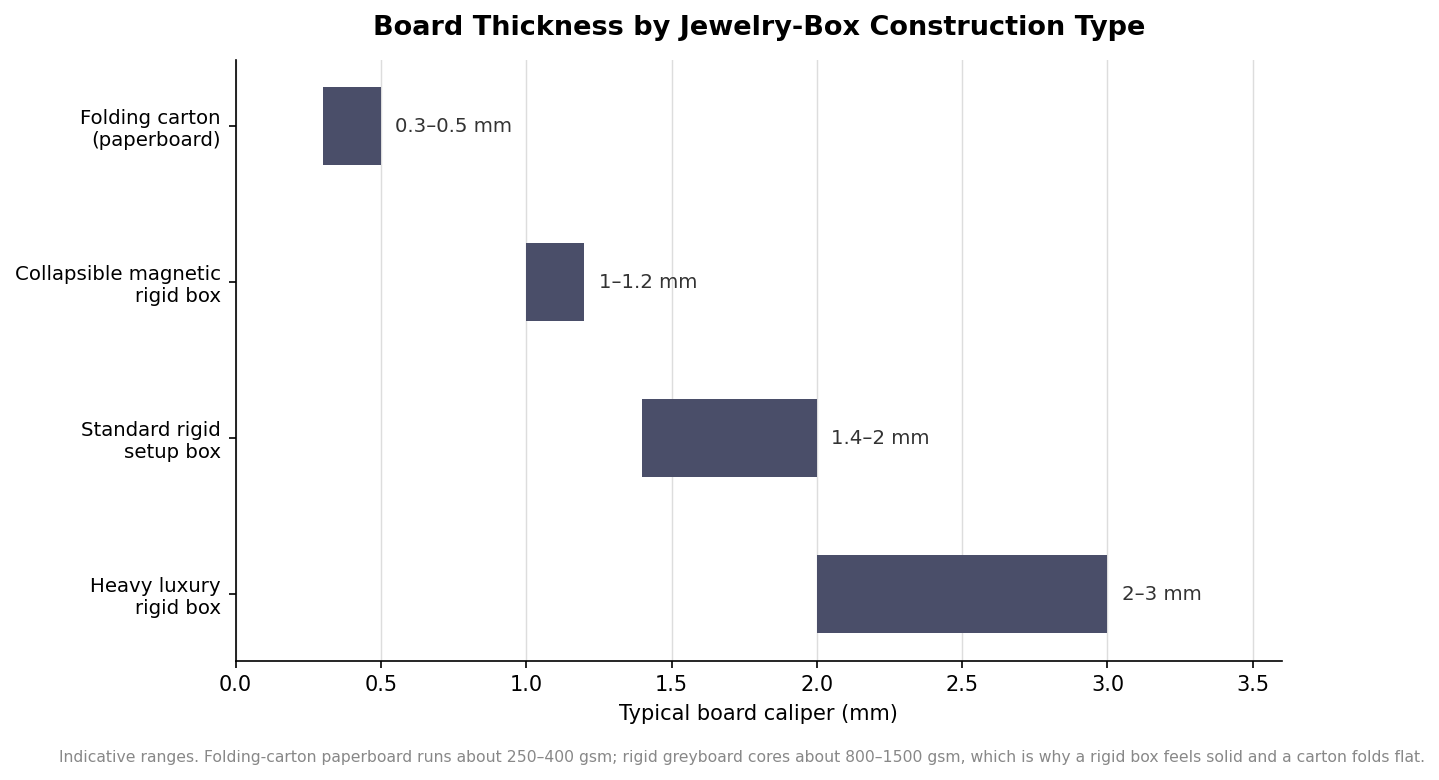
    Range chart of typical board caliper in millimeters for folding cartons and rigid jewelry-box construction types
    Rigid jewelry boxes use board three to five times thicker than a folding carton.

    The five closure styles and what each does well

    The two-piece lift-off lid, also called a telescoping or shoulder box, is the traditional jewelry box: a base and a separate lid that fits over it. It reads as premium, protects the contents well because the lid fully encloses the base, and gives you a clean surface for foil stamping on the top. Its drawback is logistics, since it arrives fully assembled and cannot be flattened, which raises shipping and storage cost.

    The magnetic collapsible lid box has become the default for gifting and PR kits for a reason. A hinged, magnet-closed lid gives a satisfying snap and a flat printable top, and the better versions ship flat and pop into shape on assembly, which cuts freight and warehouse space dramatically compared with a pre-built rigid box. Protection is good but slightly behind a fully telescoping lid, because the closure relies on the magnet rather than a lid that wraps the base.

    The drawer or slide box pairs an outer sleeve with an inner tray that pulls out like a matchbox. The tray cradles a small item extremely well, making this a strong choice for rings, earrings, and pendants, and the sliding motion feels considered. It usually ships assembled and takes more space, and the sleeve-and-tray build means slightly more material per unit. The book-style flap box opens like a hardcover, often with a magnet along the fore edge, and gives a wide, flat interior that photographs well for e-commerce and displays a necklace or a set nicely. The hinged flip or clamshell, the classic snap-shut ring box, is compact and protective and tends to be the most economical per unit, though it feels more functional than luxurious.
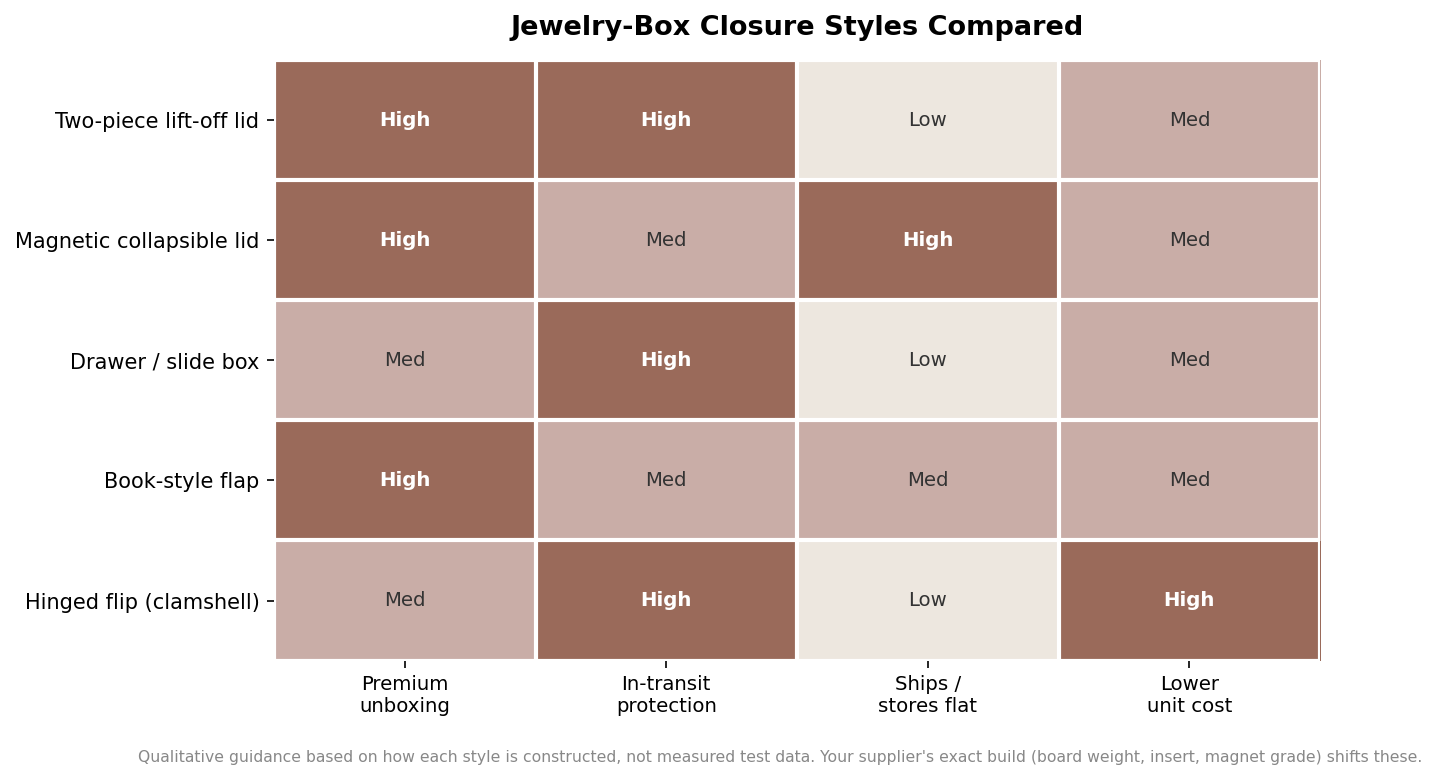
    Comparison matrix rating five jewelry-box closure styles on premium unboxing, protection, flat shipping and unit cost
    How the five common closure styles trade off feel, protection, storage and cost.

    The matrix above is qualitative guidance drawn from how each style is built rather than lab measurement, and your supplier’s specific construction will move things. A drawer box with a heavier sleeve, or a magnetic box with a thicker board and a stronger magnet, changes the feel and the protection. Use it to narrow the field, then judge a physical sample.

    Let shipping and sales channel break the tie

    Once two or three styles fit the product, how the box moves through your business often decides between them. If you sell online and fulfill from a small space, the magnetic collapsible lid earns its keep, because boxes that ship and store flat can occupy a fraction of the volume of pre-assembled rigid boxes and lower your inbound freight. If your boxes sit on a retail counter and are handed across in person, a fully assembled two-piece lid or drawer box makes a stronger impression and the storage penalty matters less. For a mailed subscription or an item that will bounce around in a shipping carton, the enclosing protection of a lift-off lid or the cradled tray of a drawer box reduces the chance of a piece shifting in transit.

    It is worth thinking one layer out, too. A rigid box is a presentation box, not a shipping box, and putting a bare rigid box in the mail scuffs the wrap and dents the corners. Most brands ship the jewelry box inside a plain corrugated mailer, which protects the finish and keeps the unboxing intact. Factor that second box into your cost and your packaging footprint from the start.

    Nail these specs before you order

    Whatever style you choose, a few details determine whether the finished box works. Size the interior to the insert, not just the item: a ring needs a slotted foam or a pillow, a necklace needs a flat pad with a hook or a bar, and the insert dimensions drive the box dimensions. Decide the wrap and the decoration, since foil stamping, embossing, and a spot finish each behave differently on paper versus fabric wraps. For magnetic styles, ask about the magnet grade, because a weak magnet undermines the whole closure and a very strong one can feel stubborn.

    Finally, get quantities and timing on the table early. Rigid box runs often start at modest minimums, sometimes as low as a dozen for stock sizes with simple branding, while fully custom sizes and elaborate finishes carry higher minimums and longer production windows. Custom rigid packaging commonly takes on the order of two to four weeks to produce after artwork approval, and longer if it ships by sea, so plan backward from your launch or your gifting date. Where a firm price, minimum, or lead time matters to your decision, confirm it on a live quote for your exact spec rather than relying on a general range, because board weight, insert, finish, and quantity all move the number.
  • What Eco-Friendly Custom Jewelry Boxes Are Actually Made Of

    What Eco-Friendly Custom Jewelry Boxes Are Actually Made Of

    Two custom jewelry boxes can look almost identical on a product photo and behave completely differently once a customer opens the mailer, keeps the box on a dresser for a year, and eventually tries to throw it away. The difference is almost always in the materials: the board underneath the wrap, the paper on top of it, the glue holding it together, and the little foam or fabric pad that cradles the ring. If you are sourcing boxes for a jewelry brand and you care about how they feel and how they are disposed of, it pays to understand each layer before you approve a proof.

    The board is the box

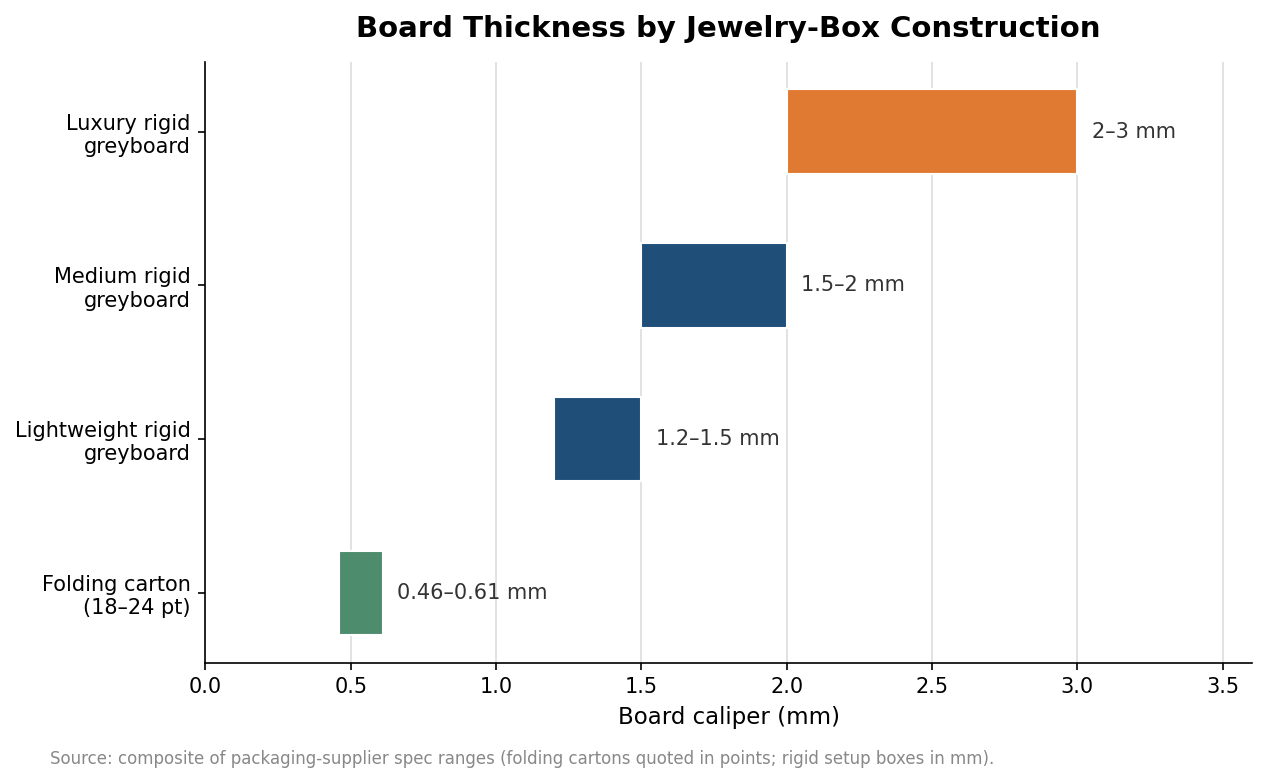
    Everything else is decoration over the board. Folding cartons — the flat-packed style that ships and stores efficiently — are typically cut from bending chip or SBS paperboard in the 14 to 24 point range, roughly 0.36 to 0.61 mm thick. A common recycled folding jewelry box runs about 18 pt (0.46 mm) of tan bending chip. Rigid setup boxes, the stiff kind that feels like a small book, are built on greyboard or chipboard measured in millimeters instead of points: lightweight rigid boxes use around 1.2 to 1.5 mm, medium-weight builds sit near 1.5 to 2.0 mm, and genuinely premium presentation boxes reach 2 to 3 mm. Thicker board resists denting and holds a crisp edge, but it also adds weight, cost, and shipping volume, so the right caliper is the one that matches how the box will be handled rather than the highest number available.

    Horizontal range chart of jewelry-box board thickness from 0.46 mm folding cartons to 3 mm luxury rigid greyboard
    Board caliper rises from thin folding cartons to 2–3 mm luxury rigid setup boxes.

    Board choice also drives recyclability from the start. Uncoated recycled chipboard and greyboard are widely accepted in curbside paper streams and will biodegrade; heavily plastic-laminated board is where problems begin. If sustainability is a real requirement rather than a marketing line, ask the supplier for the board grade in gsm or points and whether it carries an FSC claim — FSC 100%, FSC Recycled, or FSC Mix each describe a different fiber source, and “FSC Recycled” specifically means the fiber is post-consumer or pre-consumer recovered stock rather than freshly harvested.

    The wrap and the print

    The visible surface is a separate material from the board. Rigid boxes are wrapped in a printed paper — art paper for saturated color and foil compatibility, kraft for a natural look, textured or specialty stocks for a tactile finish, or SBS for crisp white graphics. Folding cartons are usually printed directly on the coated side of the board. Either way, the ink matters for both appearance and disposal. Soy-based and algae inks now reach color saturation comparable to conventional inks, including metallic effects, with lower emissions, and they interfere less with the recycling process. A one-color flexographic print with a soy or hydro ink is inexpensive and clean; multi-color offset with heavy UV coating looks glossier but complicates recycling and adds cost. Foil stamping and spot lamination are gorgeous and almost never recyclable, so they are best used sparingly on a box you expect customers to keep rather than discard.

    Where recyclability quietly breaks

    Most jewelry boxes fail the recycling test not because of the board but because of the parts bonded to it. Magnetic closures are the classic offender: the small steel or neodymium discs hidden under the wrap cannot be separated by a consumer and contaminate a paper bale. EVA foam inserts, the dense black pads that hold a ring firmly, are petroleum-based and not curbside recyclable. Velvet or flocked linings add a synthetic fiber layer fused to board. And solvent-based adhesives can bond components so tightly that even otherwise-recyclable materials can no longer be cleanly separated. A box can be 90% paper by weight and still be treated as trash if these elements are present, so if end-of-life matters to your brand, audit the closure and the insert first — that is where the damage is done.

    Recyclable alternatives that still look premium

    The encouraging part is that nearly every problem component now has a credible substitute. Molded paper pulp inserts, die-cut to hold rings, earrings, or pendants, replace EVA foam with a material made from recycled fiber that goes into the paper stream with the rest of the box. Recycled polyester flocking certified to GRS is, by most accounts, visually and texturally indistinguishable from virgin flocking while diverting plastic waste. Ribbon-and-tuck or magnet-free friction closures avoid embedded metal entirely. Water-based adhesives reach the same bond strength on paper-to-paper and paper-to-board joins as solvent glues. None of these forces a downgrade in perceived quality — a well-made pulp-insert box with a soy-printed kraft wrap reads as considered and premium, not cheap. The practical target is a box whose every layer sorts into the same waste stream, which usually means all-paper construction with a fabric insert only where it is genuinely needed.

    What the sustainable choice costs in money and time

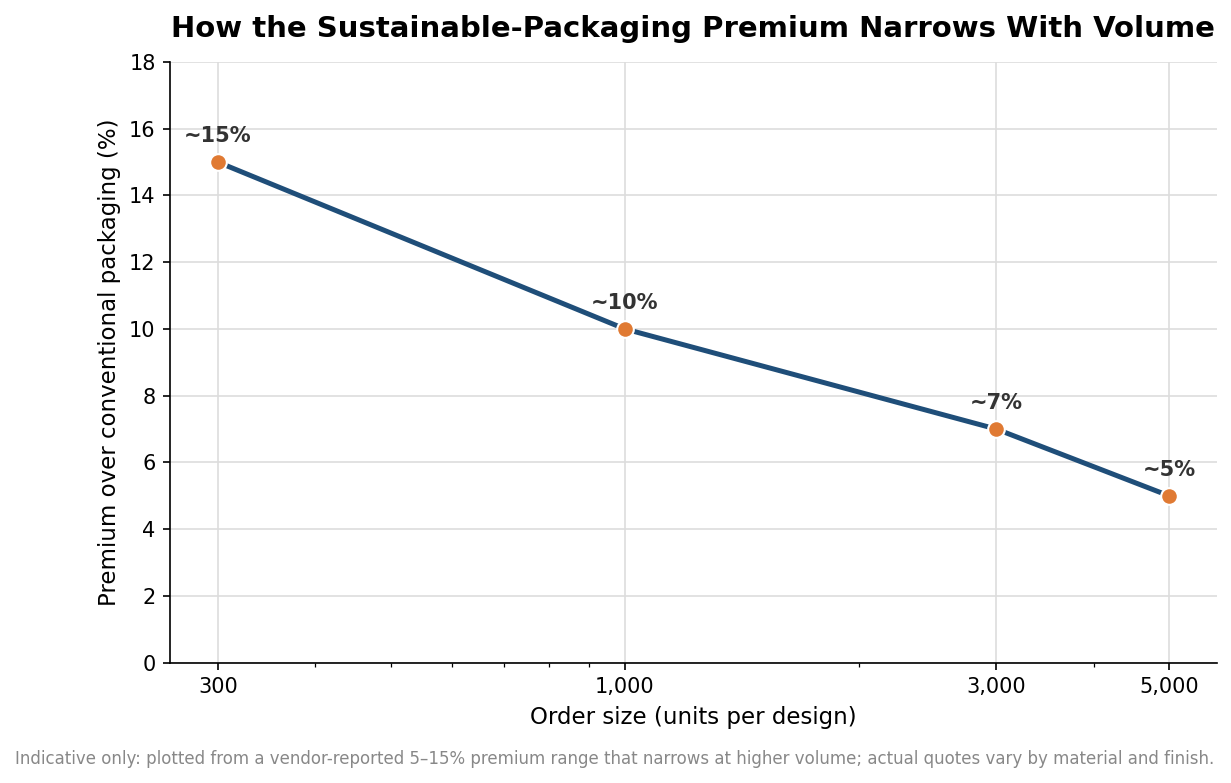
    Sustainable specifications carry a modest premium, not a punitive one. Vendors commonly quote something in the range of 5 to 15% above conventional packaging, and that gap narrows as volume rises because the fixed costs of tooling and setup spread across more units. A concrete reference point: a stock 100% recycled folding jewelry box around 3.5 by 3.5 by 1 inch, printed one color with a hydro-soy ink, has been offered near $0.71 per unit in a case of 500, curbside recyclable and made from roughly 90% post-consumer fiber. Custom work adds tooling and proofing on top of that.

    Line chart showing the sustainable-packaging cost premium falling from about 15% at 300 units to about 5% at 5,000 units
    The premium for sustainable materials shrinks as order volume grows (indicative figures).

    Timelines are the other planning input people underestimate. For custom sustainable packaging, budget roughly two to three weeks for samples and another three to five weeks for the production run after you approve artwork, and expect minimums around 300 units per design for genuinely custom construction. The recycled folding box referenced above quoted about five to seven weeks from proof approval. In other words, if you need boxes in hand for a holiday launch, the artwork needs to be locked roughly two months ahead, and the sustainability decisions — board grade, closure type, insert material, ink — should be made at the start of that window, not after the proof, because they are exactly the choices that determine both how the box feels in a customer’s hand and where it ends up when the jewelry outlives its packaging.

  • How Many Jewelry Boxes Should You Order?

    HomeBlog › How Many Jewelry Boxes Should You Order?

    Ordering

    How Many Jewelry Boxes Should You Order?

    06/29/2026

    The most common question we get on a first quote isn’t about color or finish — it’s “how many should I actually order?” Order too few and you’re paying rush fees on a reorder within weeks. Order too many and working capital sits tied up in packaging instead of inventory.

    Here’s the simple math we walk retailers and brands through on every quote call.

    Start with your sell-through, not your instinct

    Pull your last 90 days of unit sales by category — rings, earrings, necklaces, bracelets, sets — and divide by 90 to get a daily average. Multiply that by the number of days until your next planned reorder point, then add a 15–20% buffer for unexpected spikes. This single calculation prevents the two most common mistakes: ordering a flat number across every box style regardless of actual demand, and ordering the same total every quarter regardless of trend.

    Launch runs work differently than restocks

    A first order for a new collection or a new brand has no sales history to lean on, so we size it against our minimum order quantity of just 12 pieces per style and let you split it across your 2–3 best-selling categories rather than guessing evenly. Most first-time brands order 100–300 units per box style and treat the first 60 days as a live test of which style needs a bigger reorder.

    Holiday and gifting-season spikes

    Fine jewelry and gifting brands typically see 30–45% of annual jewelry box volume land in a six-week window around the winter holidays and Valentine’s Day. Plan that portion of your annual order to arrive with buffer room before the spike starts, not during it — our standard lead time is three weeks from mockup approval, and holiday-season order slots fill up in September and October.

    Key takeawayRule of thumb: order 60 days of average sell-through plus a 20% buffer for a restock, and 100–300 units per style for a first-time launch run.

    Not sure which style or finish fits your brand? Get a custom quote and we’ll recommend an option with your free mockup. See our full product lineup, read more about who we are, or browse more guides.

    More posts

  • Foil Stamp vs. Blind Deboss: Choosing a Custom Jewelry Box Finish

    HomeBlog › Foil Stamp vs. Blind Deboss: Choosing a Custom Jewelry Box Finish

    Buyer guides

    Foil Stamp vs. Blind Deboss: Choosing a Custom Jewelry Box Finish

    06/15/2026

    The single biggest decision on a custom jewelry box order isn’t size or color — it’s decoration. Foil stamping and blind debossing solve different problems, and picking the wrong one either undersells a bold brand mark or overpowers a brand that wants to feel quiet and expensive.

    Here is how the two compare across the factors that actually matter for a working jewelry brand.

    Head to head

    FactorFoil stampingBlind debossing
    Best forBold logos, maximum shelf visibility, e-commerce photographyMinimal wordmarks, quiet-luxury and bridal branding
    Cost at volumeSlightly higher per unitSlightly lower per unit
    Lead time2 weeks2 weeks
    LookMetallic, high-contrast, campaign-readyTactile, understated, editorial

    When foil stamping wins

    If your logo needs to be seen at a glance — across a retail case, in an unboxing photo, or in a product listing thumbnail — foil stamping gives you a metallic finish that catches light and reads instantly. It works especially well for e-commerce and subscription brands where a box has to sell itself in a flat-lay photo.

    When blind debossing wins

    If your brand identity leans toward quiet luxury — a minimal wordmark, a simple monogram — blind debossing presses the mark into the leatherette with no ink or foil at all, so it reads as a shadow and a texture rather than a color. Bridal and fine jewelry brands often prefer it because it photographs elegantly without competing with the piece inside the box.

    Key takeawayChoose foil stamping for a bold or multi-element brand mark that needs shelf visibility; choose blind debossing for a minimal mark and a quieter, more tactile finish.

    Not sure which style or finish fits your brand? Get a custom quote and we’ll recommend an option with your free mockup. See our full product lineup, read more about who we are, or browse more guides.

    More posts

  • Custom Jewelry Boxes as Corporate Gifts

    HomeBlog › Custom Jewelry Boxes as Corporate Gifts

    Corporate

    Custom Jewelry Boxes as Corporate Gifts

    06/01/2026

    Corporate gifting budgets get spent on a lot of forgettable things — branded tumblers, gift baskets, generic gift cards. A jewelry piece in a genuinely well-made custom box sits in a different category entirely: it signals that the gesture was considered, not templated.

    Here’s how gifting and HR teams typically deploy jewelry boxes as a corporate program.

    Client gifting vs. employee recognition

    Client-facing gifts — sent at contract renewal, a major deal close, or a holiday touchpoint — tend to use our Jewelry Set Box or Travel Jewelry Case for maximum perceived value, foil-stamped with the client relationship in mind rather than a generic corporate logo alone. Employee recognition programs, especially milestone-anniversary gifts, more often use a single Bracelet Box or Necklace Box at a lower per-unit cost but ordered at higher volume across a workforce.

    Budget math that still looks premium

    A branded jewelry box costs a fraction of what most gifting budgets assume, especially at the 100–500 unit volumes typical of a mid-size client list or department. The box itself does a meaningful share of the perceived-value work, which is why a modest jewelry piece in the right box consistently outperforms a more expensive but plainly packaged gift in post-gift surveys.

    Key takeawayA well-packaged mid-tier jewelry gift consistently reads as more generous than an expensive item in generic packaging — the box is doing real work in the perception of value.

    Not sure which style or finish fits your brand? Get a custom quote and we’ll recommend an option with your free mockup. See our full product lineup, read more about who we are, or browse more guides.

    More posts

  • Jewelry Box Sizes: Ring, Necklace, Earring, and Bracelet Boxes Compared

    HomeBlog › Jewelry Box Sizes: Ring, Necklace, Earring, and Bracelet Boxes Compared

    Buyer guides

    Jewelry Box Sizes: Ring, Necklace, Earring, and Bracelet Boxes Compared

    05/18/2026

    Six box styles cover nearly every jewelry packaging need, but picking the wrong one for a given piece either wastes interior space or crowds the item. Here’s how our core styles compare.

    Head to head

    StyleFootprintBest for
    Ring Box2 x 2 x 1.75 inSingle rings, engagement reveals, retail point-of-sale
    Necklace Box7 x 3 x 1.25 inPendants and chains up to 24 in
    Earring Box2.5 x 2 x 1.5 inStud and drop earring pairs
    Bracelet Box4 x 4 x 1.5 inBangles and chain bracelets
    Jewelry Set Box8 x 5 x 1.75 inMatched multi-piece sets, bridal party gifting
    Travel Jewelry Case6 x 4.5 x 1.5 in foldedFull collections in transit, premium gifting

    Matching the box to the piece

    A ring needs depth and a stable slot, not width. A necklace needs length so a chain can lie flat without tangling. A bracelet needs a curved cushion, not a flat one. Trying to force one universal box across every category is the single most common packaging mistake we see from brands ordering for the first time.

    Key takeawayMatch the box geometry to the piece’s shape first, then decide on color and finish — the wrong footprint undermines even the best decoration.

    Not sure which style or finish fits your brand? Get a custom quote and we’ll recommend an option with your free mockup. See our full product lineup, read more about who we are, or browse more guides.

    More posts

  • Custom Jewelry Boxes for Wedding Favors and Bridal Parties

    HomeBlog › Custom Jewelry Boxes for Wedding Favors and Bridal Parties

    Weddings

    Custom Jewelry Boxes for Wedding Favors and Bridal Parties

    05/04/2026

    A wedding is one of the few retail-adjacent moments where packaging gets kept for decades. Brides gifting matching jewelry to a bridal party, and planners sourcing favors for guests, both lean on custom jewelry boxes to make the gesture feel finished.

    Bridal party gifting

    The Jewelry Set Box is the most-requested style here, typically holding a matching necklace-and-earring set per bridesmaid. Brides commonly order in the wedding party’s color palette rather than a single brand color, and many personalize each box with an initial via blind debossing so each gift feels individually chosen even when the contents are identical.

    Favor-sized orders for guests

    For larger guest-list favors, the Earring Box or a small Ring Box at our 100-unit minimum are the most cost-effective options, ordered in a color that matches the tablescape rather than a brand identity, since there’s no logo requirement for a personal event.

    Key takeawayOrder wedding and bridal-party jewelry boxes at least 6 weeks ahead of the date to leave room for our 2 week production plus any final color adjustments.

    Not sure which style or finish fits your brand? Get a custom quote and we’ll recommend an option with your free mockup. See our full product lineup, read more about who we are, or browse more guides.

    More posts

  • How to Order Custom Jewelry Boxes: A Step-by-Step Checklist

    HomeBlog › How to Order Custom Jewelry Boxes: A Step-by-Step Checklist

    Ordering

    How to Order Custom Jewelry Boxes: A Step-by-Step Checklist

    04/20/2026

    Ordering custom packaging for the first time involves more decisions than it looks like from the outside. This checklist covers everything we ask for on a typical quote, in the order you’ll actually need it.

    Before you request a quote

    Gather your logo file (vector if you have it), your target quantity per box style, your preferred color from our standard palette or a Pantone reference, and your in-hands date if there’s a launch or event driving the order.

    During the mockup phase

    Expect a photo-real mockup within 24–48 hours of your quote request. Review it against your actual product photography if possible — colors can read differently in a mockup rendering than in person, and we’d rather catch that before production than after.

    Approval through delivery

    Once you approve, production starts the same day and ships in about three weeks. We’ll send tracking as soon as the order leaves our facility, and we keep your final specs on file for faster reorders.

    Key takeawayHave your logo file, quantity, color choice, and deadline ready before you request a quote — it’s the fastest way to a same-day mockup start.

    Not sure which style or finish fits your brand? Get a custom quote and we’ll recommend an option with your free mockup. See our full product lineup, read more about who we are, or browse more guides.

    More posts

  • Custom Jewelry Boxes for Subscription and E-Commerce Brands

    HomeBlog › Custom Jewelry Boxes for Subscription and E-Commerce Brands

    E-Commerce

    Custom Jewelry Boxes for Subscription and E-Commerce Brands

    04/06/2026

    For a subscription or e-commerce jewelry brand, the box is the only physical brand touchpoint most customers ever get. It has to survive a shipping carrier and still perform as a premium unboxing moment on arrival.

    Built to ship, not just to display

    Rigid chipboard construction matters more for e-commerce than retail, since these boxes travel through a fulfillment network rather than sitting on a shelf. A folding paperboard box that looks fine in a showroom often arrives crushed at a customer’s door; our leatherette-wrapped rigid construction holds its shape through standard parcel handling.

    Unboxing content is free marketing

    Brands that invest in a distinctive box color and a clean foil or deboss mark consistently see more organic unboxing content shared by customers — and that content is functionally free advertising. The Necklace Box and Jewelry Set Box perform particularly well on camera because of their wider lid surface.

    Key takeawayA box built to survive a shipping carrier and still photograph well on arrival does double duty as packaging and as marketing content.

    Not sure which style or finish fits your brand? Get a custom quote and we’ll recommend an option with your free mockup. See our full product lineup, read more about who we are, or browse more guides.

    More posts

  • A Retailer’s Guide to Jewelry Box Margins

    HomeBlog › A Retailer’s Guide to Jewelry Box Margins

    Corporate

    A Retailer’s Guide to Jewelry Box Margins

    03/23/2026

    Packaging is a real cost line, but it’s also a margin lever most retailers underuse. Here’s how to think about custom jewelry box cost against the price of the piece it holds.

    Packaging as a percentage of unit price

    Most fine jewelry retailers we work with target packaging cost at roughly 1–3% of average unit retail price. Across our range of styles, that math works comfortably for pieces retailing from a quoted price upward, and comfortably justifies premium packaging even on mid-tier price points.

    Volume tiers change the math fast

    Per-unit pricing drops meaningfully between 100, 500, and 2,000-unit order tiers. Retailers who consolidate packaging orders across multiple store locations or seasonal collections into a single larger order, rather than reordering small batches per location, capture that volume discount instead of leaving it on the table.

    Key takeawayTarget packaging at roughly 1–3% of average unit retail price, and consolidate orders across locations to capture volume pricing tiers.

    Not sure which style or finish fits your brand? Get a custom quote and we’ll recommend an option with your free mockup. See our full product lineup, read more about who we are, or browse more guides.

    More posts