Two custom jewelry boxes can look almost identical on a product photo and behave completely differently once a customer opens the mailer, keeps the box on a dresser for a year, and eventually tries to throw it away. The difference is almost always in the materials: the board underneath the wrap, the paper on top of it, the glue holding it together, and the little foam or fabric pad that cradles the ring. If you are sourcing boxes for a jewelry brand and you care about how they feel and how they are disposed of, it pays to understand each layer before you approve a proof.
The board is the box
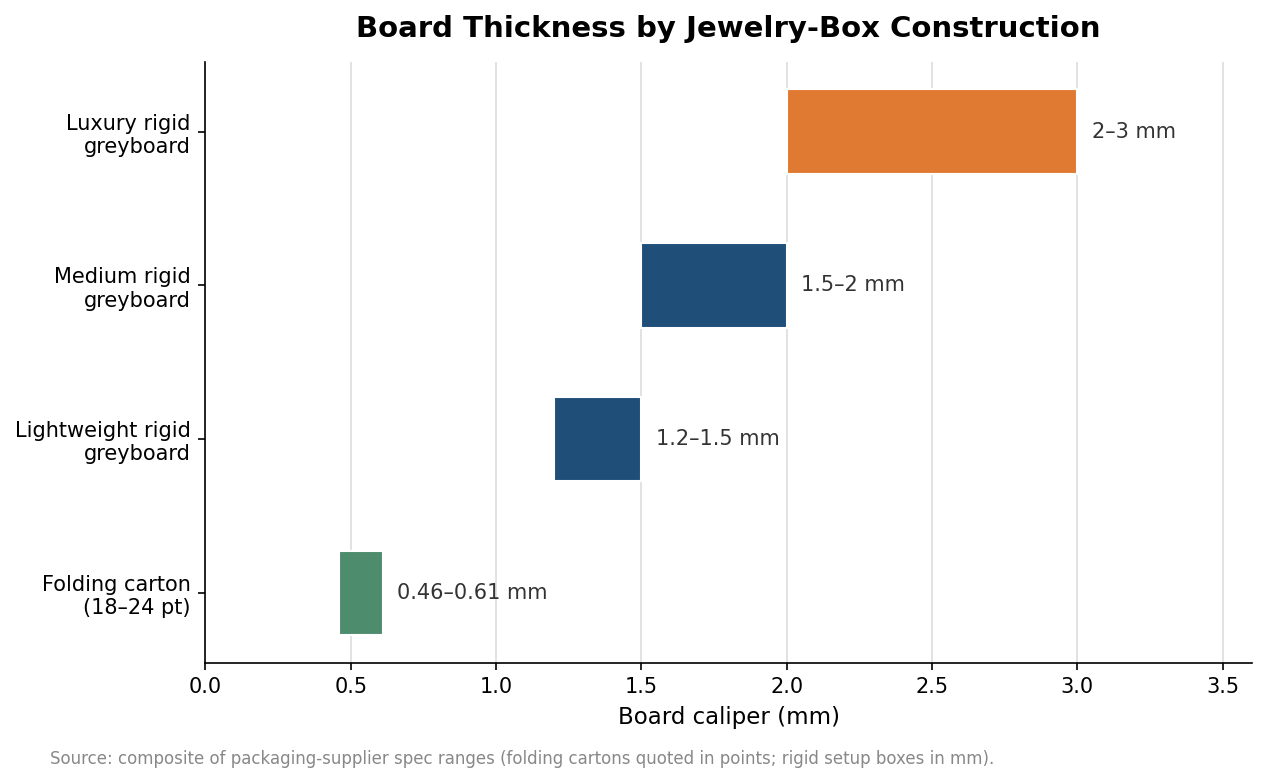
Everything else is decoration over the board. Folding cartons — the flat-packed style that ships and stores efficiently — are typically cut from bending chip or SBS paperboard in the 14 to 24 point range, roughly 0.36 to 0.61 mm thick. A common recycled folding jewelry box runs about 18 pt (0.46 mm) of tan bending chip. Rigid setup boxes, the stiff kind that feels like a small book, are built on greyboard or chipboard measured in millimeters instead of points: lightweight rigid boxes use around 1.2 to 1.5 mm, medium-weight builds sit near 1.5 to 2.0 mm, and genuinely premium presentation boxes reach 2 to 3 mm. Thicker board resists denting and holds a crisp edge, but it also adds weight, cost, and shipping volume, so the right caliper is the one that matches how the box will be handled rather than the highest number available.
Board choice also drives recyclability from the start. Uncoated recycled chipboard and greyboard are widely accepted in curbside paper streams and will biodegrade; heavily plastic-laminated board is where problems begin. If sustainability is a real requirement rather than a marketing line, ask the supplier for the board grade in gsm or points and whether it carries an FSC claim — FSC 100%, FSC Recycled, or FSC Mix each describe a different fiber source, and “FSC Recycled” specifically means the fiber is post-consumer or pre-consumer recovered stock rather than freshly harvested.
The wrap and the print
The visible surface is a separate material from the board. Rigid boxes are wrapped in a printed paper — art paper for saturated color and foil compatibility, kraft for a natural look, textured or specialty stocks for a tactile finish, or SBS for crisp white graphics. Folding cartons are usually printed directly on the coated side of the board. Either way, the ink matters for both appearance and disposal. Soy-based and algae inks now reach color saturation comparable to conventional inks, including metallic effects, with lower emissions, and they interfere less with the recycling process. A one-color flexographic print with a soy or hydro ink is inexpensive and clean; multi-color offset with heavy UV coating looks glossier but complicates recycling and adds cost. Foil stamping and spot lamination are gorgeous and almost never recyclable, so they are best used sparingly on a box you expect customers to keep rather than discard.
Where recyclability quietly breaks
Most jewelry boxes fail the recycling test not because of the board but because of the parts bonded to it. Magnetic closures are the classic offender: the small steel or neodymium discs hidden under the wrap cannot be separated by a consumer and contaminate a paper bale. EVA foam inserts, the dense black pads that hold a ring firmly, are petroleum-based and not curbside recyclable. Velvet or flocked linings add a synthetic fiber layer fused to board. And solvent-based adhesives can bond components so tightly that even otherwise-recyclable materials can no longer be cleanly separated. A box can be 90% paper by weight and still be treated as trash if these elements are present, so if end-of-life matters to your brand, audit the closure and the insert first — that is where the damage is done.
Recyclable alternatives that still look premium
The encouraging part is that nearly every problem component now has a credible substitute. Molded paper pulp inserts, die-cut to hold rings, earrings, or pendants, replace EVA foam with a material made from recycled fiber that goes into the paper stream with the rest of the box. Recycled polyester flocking certified to GRS is, by most accounts, visually and texturally indistinguishable from virgin flocking while diverting plastic waste. Ribbon-and-tuck or magnet-free friction closures avoid embedded metal entirely. Water-based adhesives reach the same bond strength on paper-to-paper and paper-to-board joins as solvent glues. None of these forces a downgrade in perceived quality — a well-made pulp-insert box with a soy-printed kraft wrap reads as considered and premium, not cheap. The practical target is a box whose every layer sorts into the same waste stream, which usually means all-paper construction with a fabric insert only where it is genuinely needed.
What the sustainable choice costs in money and time
Sustainable specifications carry a modest premium, not a punitive one. Vendors commonly quote something in the range of 5 to 15% above conventional packaging, and that gap narrows as volume rises because the fixed costs of tooling and setup spread across more units. A concrete reference point: a stock 100% recycled folding jewelry box around 3.5 by 3.5 by 1 inch, printed one color with a hydro-soy ink, has been offered near $0.71 per unit in a case of 500, curbside recyclable and made from roughly 90% post-consumer fiber. Custom work adds tooling and proofing on top of that.
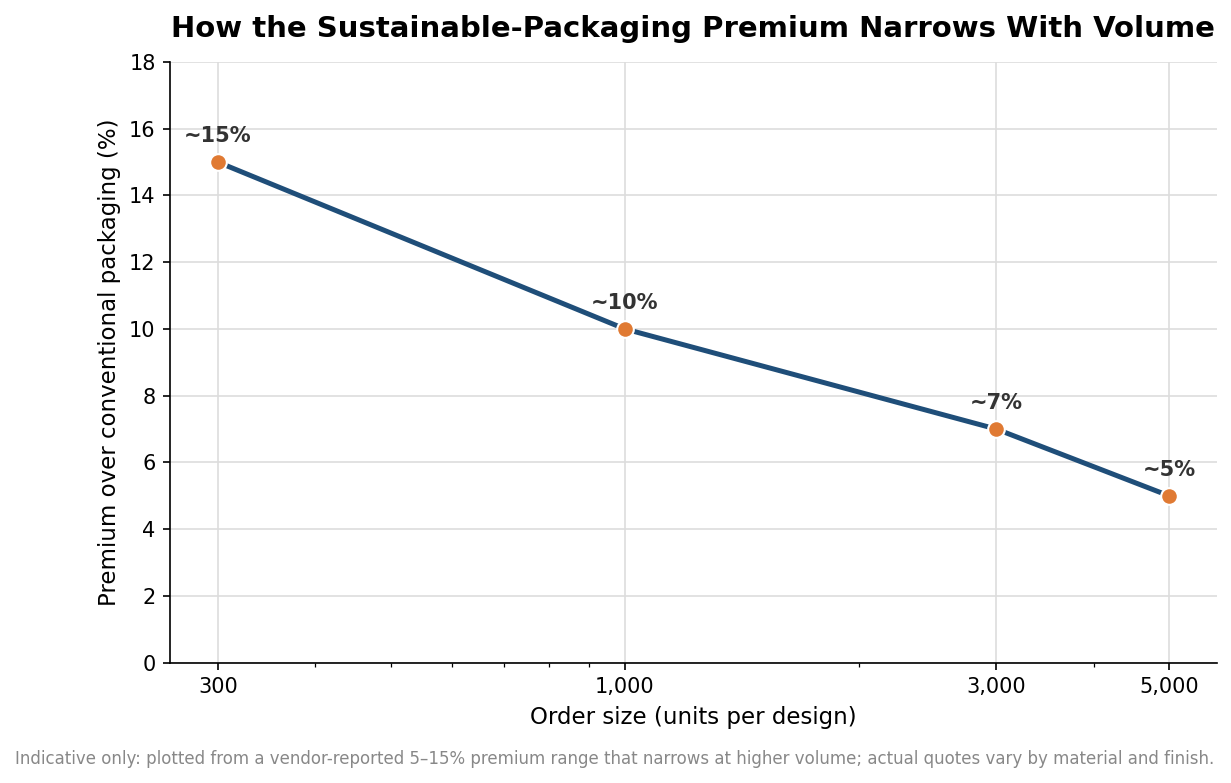
Timelines are the other planning input people underestimate. For custom sustainable packaging, budget roughly two to three weeks for samples and another three to five weeks for the production run after you approve artwork, and expect minimums around 300 units per design for genuinely custom construction. The recycled folding box referenced above quoted about five to seven weeks from proof approval. In other words, if you need boxes in hand for a holiday launch, the artwork needs to be locked roughly two months ahead, and the sustainability decisions — board grade, closure type, insert material, ink — should be made at the start of that window, not after the proof, because they are exactly the choices that determine both how the box feels in a customer’s hand and where it ends up when the jewelry outlives its packaging.
Leave a Reply